


 Laura BuckleyThe Magic Know-How |
|---|
 IMG_2361.jpg |
 IMG_2360.jpg |
Site Gallery Visit - THE MAGIC KNOW-HOW 10 August - 21 September 2013
Laura Buckley’s installation was of great interest to me when I first saw it advertised on the Site Gallery’s website, as it had strong correlations to my major project idea Focal which was in the latter stages of development at the time. ‘Buckley is renowned for her all encompassing, sound, light and video projected installations’ (http://www.sitegallery.org/archives/6096 date last visited 30/10/13) which is the area to which I want to explore within my own practice.
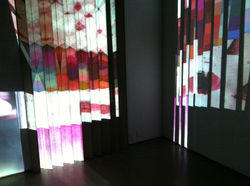
The installation manipulated light and sound, utilising reflections and various materials. The back room had a large structure with a translucent material, which was projected upon, allowing you to enter into the structure, becoming encapsulated by the piece. The image left shows the interaction between structures and projection, using mirrored slats creating refractions of light and abstract images and shapes. It was a very intriguing successful piece which is definitely relevant to both my interim project development project SIFT RAM MEM and the major project FOCAL.
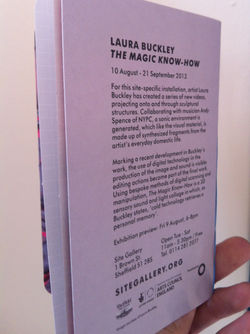
Something what I took away from this installation was a little book; on the side was a pile of covers with the information of the installation on, some paper pages and a rubberband, which you could pick up and make a sketchbook out of, then make little sketches as you went round the installation. I thought this was a really clever way of getting viewers engaged with the piece as well as creating a lasting experience, as they get to take home their experience of the installation in the little notebook. As SIFT RAM MEM is based upon memories I thought it would make a great addition as people could write down their experience or even their own memories, if it manages to spark a connection with the viewer.
Mariele Neudecker
Mariele Neudecker's tank works was very striking for me instantly sparking a connection, recreating whole environments and atmospheres, challenging the way that we percieve. There is the obvious strong visual effect utilising multiple mediums. In particular image right featureing 3 tanks in a row explores the foreground, midground and background, which are interchangeable as you move around the piece, peering through each end you get the depth as well as a sense of how an image is constructed within photography, film, art, and the real world.


The original vision for the spherical sculptures below was to represent the human eye, taking consideration into the way we percieve the world, however this was reinterpreted for an exhibition dealing with climate change, 'the wax was interpreted to be ice caps' and the two poles of the earth, this wasn't however her intention, it was about how we interpret the earth and landscapes through our vision. Is this a problem though? 'there isn't an objective reading of such a thing, everybody brings in their readings', what she was really trying to do was 'to open it up to subjective reading'. Which as with the intention of my piece if the viewer doesn't interpret the piece as a reflection of the brief, this isn’t a problem, it doesn't make it a failure. The main aim of the piece is to engage the viewer. Opening up subjective readings of a piece creates so much more depth and meaning then something which is handed over to the viewer on a plate, it is in my view the core of an installation piece. (http://www.marieleneudecker.co.uk site last visited 23/11/13) (Neudecker, M. Artist's talk 8/5/13, The air itself is one vast library, Brighton Festival. http://www.youtube.com/watch?v=bsXit-oByAM last visited 23/11/13) (http://www.lighthouse.org.uk/programme/mariele-neudecker-the-air-itself-is-one-vast-library, last visited 23/11/13)


Thomas Köner

Thomas Köner is an intriguing multimedia artist, with interests in combining visual and auditory experiences. His piece La Barca (2009) is of particular interest, portraying an illusionary experience (image left) as we travel through the city of Tokyo. With bass gravel tones which allow you to feel and become involved within the sound. This is very much the style of sound piece which I was imagining and had described to Ruby during the initial developed thought meetings. The layering of effects and lighting within the image are visually strong with an abstract element, as we travel through the space, the combined sound design proves for an involving experience. The way in which time is manipulated within the piece is also of interest.
NUUK (Day) (2004) another installation by Köner presents an interesting time lapse which isn't done conventionally, instead of capturing the movement of the cityscape, people and cars, he uses far fewer images using what I assume are slow crossdisolves, so instead of capturing the life of the city it's transformed into something much more desolate, as there is no movement, despite the movement of time from day into night. Bringing up the huge philosophy's surrounding time.
http://www.koener.de/index.htm (date last visited 03/11/13) https://vimeo.com/53668425 (date last visited 03/11/13) http://www.youtube.com/watch?v=hieK8kI9o5A (date last visited 03/11/13) http://www.youtube.com/watch?v=UbfUd8eyUJs (date last visited 03/11/13)
Andrei Tarkovsky


It is rare that I ever make a piece of film without drawing some influence from the cinematic great Andrei Tarkovsky, you can see the similarities between the image from my film left, which reminded me of this shot from Mirror (1975 D. Tarkovsky, A) right, certainly in composition and subject matter. In comparing these images it has provoked a thought; instead of portraying a character I am presenting a head space for the audience to enter into. This too is a device used by Tarkovsky allowing us to enter into a characters head space, a characters thoughts and memories, as with the long take which progresses through an empty old house as we view a dying mans memories in Mirror (1975 D. Tarkovsky, A. 00:19:20 - 00:21:26). A great quote from Tarkovsky which I've used before but think it's relevant ‘Bereft of memory, a person becomes the prisoner of an illusionary experience; falling out of time he is unable to seize his own link to the outside world – in other words he is doomed to madness.’ (Tarkovsky, A. 1987) Without being able to keep hold of our memories we are doomed, with no past there is no expectation of future, presenting an impossible ever presence.
Tarkovsky, A. (1987) Sculpting in Time: Reflections on Cinema. University of Texas Press.
NAM JUNE PAIK
'He is commonly accepted as a pioneer of video and media art, who helped these genres gain recognition through his innovative, neo-Dadaist employment of technology, experimentation and performance' (Sook-Kyung, Lee. 2010 pg.9), This is a key artist in the development of video art, whom I need to research to evaluate the contextual positioning of my own work. He is a hugely inspirational artist within the film art world.

Zen for TV 1963/82
Marcel Odenbach Collection

Moon Is the Oldest TV (1965/92)
centre Pompidou, Paris
Musée national d'art moderne/centre de création industrielle
Laser Cone (2001/2010)
Nam June Paik Estate/Norman Ballard
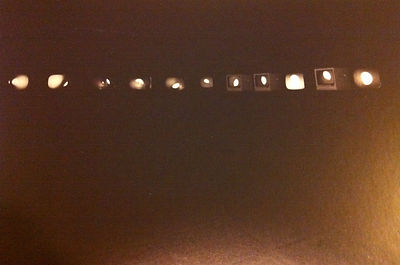
A substantial part of his work was turning an object which served a function into a piece of art, through physical manipulation of imagery. As a contemporary viewer the old tv sets form intrigue in themselves, fulfilling a huge visual aesthetic. However as digital media progressed so to did Paik, as seen image right, using lasers to create an involving visual experience. (http://www.paikstudios.com last visited 20/12/13) (ed. Sook Kyung, Lee. (2010) Nam June Paik. London, Tate. Published to accompany exhibition.
Installation Art
Installation art can refered to as 'a kind of art making which rejects concentrating on one object in favor of a consideration of the relationships between a number of elements or of the interaction between things and their contexts.' (De Oliveira, Nicholas. 1994. Pg.8). Which as the project develops I'm coming to understand, trying to work out the harmony of multiple elements and how each one will effect the other.

At the dawn of modernity artists had a new opportunity to come up with new creative responses to art. Marcel Duchamps Fountain (1917) and Bicycle Wheel (1913) posed the idea of the ready made, an artist can take any object and call it art and then it was arguably so. As a celebration to new technology by using mass produced objects and a new pace of life. Whatever your view this fits within the history
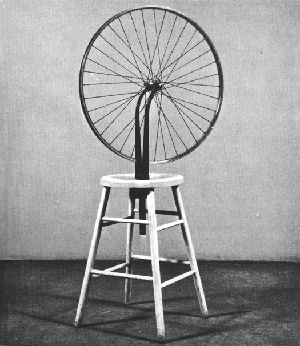
of modern art, under the Dadaist movement, whom flouted conventional aesthetic and values, producing work brandished by nonsense, travesty and incongruity, moreover working as a response to WW1 by challenging the establishment. This challenged the meaning of art from which Installation developed. “The creative act is not performed by the artist alone; the spectator brings the work in contact with the external world by deciphering
and interpreting its inner qualifications and thus adds his contribution to the creative act.” - Marcel Duchamp. This is a very relevant quote from Duchamp for me on my own practice, as stated before I do not see the installation as a failure if people don't see how it links to memories, my aim is to create something open to subjective interpretation, each individual contributing to the experience. I can clearly see how the foundations laid down by Duchamp feed into my own practice, understanding the context to which I am working.
(De Oliveira, Nicholas. (1994) Installation Art Thames and Hudson).
Bill Viola


Bill Viola is another big name in contemporary video art, whose work often focuses the fundamental human experiences. What's quite interesting is that the image top left is very similar to one of my own initial concept drawings, it is really good to see it working, looking a lot more effective than I had previously imagined. As people interact and move around the piece it wouldn't surprise me if the fabric moved creating an interesting visual experience. Image right deals with similar subject matter to my brief entitled theatre of memory, the physical presense of the sounds source, of the bells attached to the branches, juxtaposing to a static humm sound design, is something really interesting, adding another layer of complexity, and how these work together.
Stations 1994 Bill Viola
The Veiling 1995 Bill Viola
Theatre of memory 1985 Bill Viola
Gary Hill

'Gary Hill won the Leone D'Or for best sculpture at the 1995 Venice Biennale. Hill's work often incorporates poetic and/or philosophical texts of his own or of such writers as Maurice Blanchot, Gregory Bateson, Martin Heidegger, and Ludwig Wittgenstein.' (http://atc.berkeley.edu/bio/Gary_Hill/ last visited 29/12/13) In my view a good installation should draw the visitor in, encouraging them to interact with and explore the space, as apposed to going to look at something. Which is what drew my attention to Withershins (1995), whilst the ankle high maze wouldn't be a challenge to navigate, the pressure triggered human voices which change dependent on where you go combined with projected image, creates an intriguing experience, enticing you to explore the whole maze inclusive of the dead ends. Interactive sound design is certainly an area of interest for my future works.
Mirror 1975
Fountain 1917
Bicycle Wheel 1913.
Hill, G. (2000) Gary Hill. JHU press
(Upchurch, M. A stroll with sound/video artist Gary Hill through his new show. http://seattletimes.com/html/thearts/2018126695_ar06hill.html date last visited 29/12/13)
(http://www.frieze.com/issue/review/gary_hill/ last visited 29/12/13)(http://www.eai.org/artistBio.htm?id=454 date last visited 29/12/13)
Withershins (1995) Gary Hill