


Starting Point
Brief
How do we keep hold of our memories?
Create an interim version of your Major Project as an installation, in a gallery space open to
the public for at least one day.
Initial Reactions
When we first presented with the brief, or should I say the first time it was hinted that we had to come up with an installation by Christmas, it came as quite a shock, considering most galleries pre-book sometimes up to a year and a half in advance. Moreover, the original pitch idea, for the major project, I began developing back in June having 4 months of constant development, playing with ideas in my head and considering feasibility, how I would execute such a project. To then be given the test of coming up with a new idea for an installation, following the pitching process for the previous project, seemed like a big challenge. However, this didn’t deter me, from my experience of visiting installations I new that simplicity can work very effectively within a gallery space, and this being my first installation I new I had to keep it simple. My first step was to book the gallery space, luckily Joe Maloney became producer for the project at this slightly later stage, which took a huge pressure off the work load as I was currently contending with being producer, director, artist, he managed to book a 2 day slot with bloc projects Sheffield at the same time as AV13 18/19th December. We did consider doing a 24 hour installation which would have involved working through the night to put the installation up, opening in the day and taking down at night, which whilst Ruby and I thought this was achievable, alongside the producer we decided to go for two to give ourselves some breathing room, this would also allow us to put on an opening night event.
Gallery Space: Bloc Projects
About
Gallery Address: 71 Eyre Lane, Sheffield, S1 4RB
'Bloc Projects is an artist-led project space with an annual programme of exhibitions, events, residencies, exchange projects and educational activity in our gallery and courtyard spaces.
Established in 2002, the organisation provides a platform for early-mid career artists to develop new work and present existing work to new audiences. Bloc Projects supports gallery based our outdoor works, performance, off site projects, research projects, artist-led publishing and cross-disciplinary collaborations, and invites critical dialogue among artists and audiences.
Throughout its history Bloc Projects has supported artists and artist groups from across the UK and Europe working in a wide range of media, delivered partnerships projects with organisations such as Compass Live Art, Sheffield Fringe and Sensoria Festival, and operated as part of the Art Sheffield Consortium.
Bloc Projects is lead by two co-managers and a small board of directors:
Rebecca Bowley – Manager, Director.
Lesley Guy – Director.
Dominic Mason – Director.
Charlotte Morgan – Manager.
The gallery is based at Bloc Studios, a partner organisation. While Bloc Projects was originally founded by staff and members of Bloc Studios, the studios maintain operationally and financially independent of the gallery. Find all information relating to the studios’ history, artists and vacancies at the Bloc Studios website.'
(Bloc Projects http://www.blocprojects.co.uk date last visited 05/11/13)
 Floor Plan |
|---|
 Floor Plan |
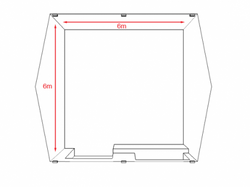 Floor Plan |

Initial Ideas
The initial ideas for the project were quite hard to come up with as previously said having to put the major project on the backburner in my head. What we had was a space, a near perfect square. Meeting the group I challenged them by drawing a square and said you can have anything within this square but what's in the square can effect outside of the square. Like the space we had, installations should, in my view, provide an experience and whilst contained within it's setting, the experience we have can last outside of the installation challenging the way we think or percieve.

As part of the creative process I decided to hire out a projector and experiment with how you could manipulate the projected image, the effects of different materials and translucencies. Whilst testing it's effects when projected through paper, which created an interesting textured image showing up the fibers of the paper, it also created an interesting almost surreal effect when suspended. The image was static but the paper was flowing, it was like holding a paper screen where the image wasn't attached. This made me consider creating multiple obstructions through different depths and heights of the image, which when viewed from a specific angle created the whole image. However, this seemed to be quite a large complex structure to execute within the given time.

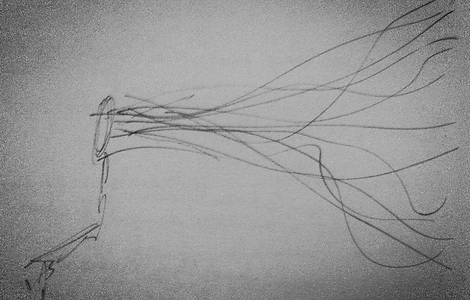
Concepts
Here are some initial concept drawings for the installation piece, the one to the right was inspired by a multi media monologue performance piece I viewed at Edinburgh festival several years ago, which has always stayed in my mind. It utilised several layers of semi-transparent fabric, which was projected onto with written words, as the actor wove in and out of the space during acting the piece. I liked the way the material captured the light on several planes, establishing the 3 planes of sight. This is also mimetic of how we store information or memories through visual stimulus; we can't capture and keep hold of all the information presented to us, instead we have hazy fragments which fade through time. Moreover, taking into consideration how we capture memories through photography and film into a solid state, which can outlive the beholder, presenting atemporality within our temporal lives.
This was a much more conceptual idea, going off the brief as a interim project, I took the willow branches from FOCAL and thought about suspending them mid air, with a chair for either a performance piece or for viewers to interact with. Each individual mind is so unique and complex, with endless memories. The twisted willow branches acting as a metaphor of memories pouring out. Again this seemed quite complex in the technical execution. I'm feeling very rushed to concept an idea within the given time whereas normally I would get a spark which would ignite in my mind, an idea constantly developing and growing stronger over a long period of time, over complicating, before stripping back, seeing how far you can take something before it becomes too far, to balance and idea and focus your mind. I need to change my approach for this before I become lost. I also feel more insight and research is needed, to get some visual stimulus.
Developed Thought
After filling a head with multiple complex ideas I decided to start again, tabula rasa. I looked at the components of the FOCAL and looked at what elements need to be built, as this is an interim project I saw a good opportunity to pre make one of the element. So I started with a paper cube, keep it simple I told myself, just a paper cube. Though not simple in it's construction it is very minimalist in appearance.

This paper cube will take on a complete new meaning, forming, representing a storage center for memories, entertaining the process of mass storage of peoples lives, the methods we use, how we can capture memories both physically and digitally. Stored either printed or in digital form for potential eternity, or at least as long as the humanity exists to protect it. The atemporal offerings of new digital media which allows our memories, the things that make us unique live on way beyond our temporal end. The sound design at times representing the feeling of sifting through memories, unable to physically grasp them, as we flow through a visual representation of the past. Consideration also has to be paid to the senses, when remembering a specific period in time it has a very distinct feel, how could you recreate this feel through the senses? sight, touch, sounds and smells.
Ruby the sound designer and myself worked closely together throughout the conception stages of the project. Once we had the core idea of the central cube, representing a storage center or
human brain, we pretty much bounced ideas off of each other and Ruby came up with instead of having one sound design piece, we would have two interwoven pieces working together. The exterior sound will represent the confusion interruptions, distractions and chaos of life, yet how within this we still manage to find moments of clarity. Which is when the interior sounds of thoughts and emotions will bubble up from inside of the cube in the form of human and digital voices, representing the vastness of human memory, the omnipresence, how we can visualise and sift through uncountable memories, with the ability to isolate a specific point. Creating two separate sound tracks that will weave in and out of each other, creating an interactive sound environment. This seemed to me very ambitious for the short period of time that we had, so I made sure Ruby definitely felt confident that it was feasible within the time period, ambition is good but feasibility is a very important part of any project. However, Ruby managed to convince me that she could do this within the time given, installing a lot of confidence. I view this as 'our' project and I want her to do something she wants to do. My approach to Directing especially with this project is that if someone is doing something they want to do, something they can love and enjoy creating will create a far better outcome then someone who is doing it as a chore, with me or the university as a taskmaster. This should produce a much more dedicated crew. I view Ruby as sound artist within her own right and we are coming together to create something between us as equals. I have great confidence in Ruby and our future work relationship, already she has very similar ideas to me, she took the initial direction for both projects very well, getting excited by them and inputting her own creativity.
The purpose of this project development module is to be given a brief which is designed to iron out any problems that the tutors could see occurring within our major project, learning from our mistakes so that we can overcome them for our major project. From this, the brief and the tutors, I understood the brief to create an interim version of the installation, and it was set because I hadn't done an installation before. I took from this that they wanted me to physically construct something and install it within a gallery space. Therefore, for me the image or film in itself wasn't the priority or most important element. However, it is still an element which needs to be considered, as the major project involves multiple projections. My major vision for this piece however is the sculpture and the sound design, the image is going to act as a secondary visual stimulus which will allow the audience to connect to the piece. My initial thoughts for this is to include images of desolate landscapes, representing a thought space. I initially toyed with the idea that these landscapes, which seem very desolate, actually hold allot of meaning and memories to me, inserting myself as the artist into the piece. However, whilst this may be true I see it more as a thought space, I want it to be very plain and basic, with long takes and minimal editing, maybe inputting the odd interruption. The reasoning behind this simplicity is that I have to consider how each individual element is going to work in harmony and how this is going to effect the viewer. The sound is quite complex, the lighting and sculpture are a major point of interest in themselves, I don't want people to focus in too much on the image, distracting them from the overall experience.
Having formed our idea I had a tutorial with Neil Webb, a Sheffield based media and sound artist and senior lecturer at Hallam. I feel very privileged to have him overseeing the project as it is very much his own specialism and is experienced in the field. He gave allot of interesting and potential avenues to go down which I hadn't thought of, bouncing ideas around. Below are the meeting notes which I typed up and posted onto the group facebook page as not everyone was available at the time of the tutorial, I then had a meeting with Ruby to further discuss the developments in the sound design. He also gave lots of inspiring research materials to be getting on with, which was very helpful as I need to realise the context in which my work will be sitting as this is my first installation, though I have visited a fair few before this project.
Saturday, 26 October 2013
Neil meeting notes
- Narrative of the sound e.g. Humorous, slice of life, trivial, philosophical, a mixture? The sound creates the narrative.
- Use of clear voices from lots of different people, computer voices, a mixture of thoughts, memory data information, digital. Represent both human thought and the digital storage creating a mix.
- Dry information? Artificial
- Something constantly alive muttering under the surface, like a conscious.
- Keep tutors informed throughout
- Create a "third eye", non synch sound, combined with image, fairly neutral.
- Time and memory - pacing - slow - hyperactivity - dynamic mix
- Slow gentle image mixed with fast sound - create juxtapositions between the two, then move into moments of harmony.
- Project bubbles of knowledge, create a continuous stream of information.
- Interrupting, an obvious glitch in the image, playing with time - a loop.
- What and why is it interrupted? Unrelenting persistence of thought and memory.
- Create an omnipresence within the sound design, e.g a gravel tone (create unrelenting persistence as with thought and memory.)
- Stock exchange, think about mechanical, digital information.
- Organic sounds.
- Quality of thought is very important here for marking purposes.
- Combine images with sounds for the blog, test out ideas, blog needs quantity, keep tutors informed of progress.
- How to be involved in an image, consider different angles
- Landscape - manipulation of objects
Something which I found interesting was the idea of creating a "third eye", by not synching both sound and image it creates a "third eye" where each individual connects the two elements together forming their own interpretations to create a whole. Every point above is something which I want to involve within the installation and in the development process.
Tutorial Neil Webb


Initially I wanted to set out the cube size so that I could understand what I'd be working with, a good size seemed a meter cubed, so I physically set that out with sticks and masking tape. This initially seemed very big within the setting of my room which was concerning at first, but came round to its size and thought within the gallery space it would work very effectively. I also got out a small projector from stores to see if it would focus that short a distance as well as the size of the screen itself, mapping out the measurements (image left). The image was ever so slightly out of focus, I also considered the heat of having two projectors within a cube, therefore I saw these projectors as back up options. From this I decided to source some mini projectors, as they would be smaller, take up less space, produce a bigger image, create less heat and focus at shorter distances. After spending some time researching the best options I managed to find an electrical equipment supplier who supplied them for £100 below RRP, giving me the option to sell the projectors for the same money or more at the end of the installation. During this time I also sold my mx5 and bought a people carrier at auction, because I would need one for the size and quantity of materials required. In hindsight I would say I probably took on a bit too much and overloaded my brain.
Mapping Out The Cube


Bloc Projects Visit
I decided to organise a group visit to bloc projects, to give everyone a sense of the space in which the work will be shown. This was a great stimulus for the group, we visualised roughly what would go where. The roof support in image right was quite an interesting structure, which reminded me of something Neil said in the tutorial, utilising the space and it's shapes, as well as the idea of having a third eye. I considered having translucent material covering the central triangle with the image of an eye blinking occasionally at random, flashing up, though this could be too much of a distraction. Aside from this it could be an awkward structure in terms of the positioning of the cube and the rooms symmetry.
Sound/Image Test
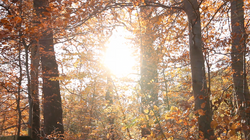
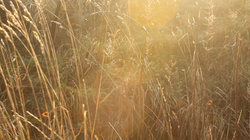
We decided to shoot some test footage on a phone, whilst Ruby created a test sound design piece, so that we could establish the feel of the piece, whilst also checking that the image and sound work together to create what we wanted from them. Overall I would say both were fairly successful, creating an interesting harmony. Consideration will have to go to the high contrast of light in shots of the woodland, though a higher quality camera should have a higher dynamic range. There is a mixture of shots which will be used, mainly as a thinking space, from desolate open countryside with orange browned heather, contrasting to the dense inner woodland, planted by humans with cut out channels, form serving a function. The omnipresence of evergreens juxtapose to the images of the deciduous trees, as the leaves fall and decay representing the temporality of life, with reference to seasons, repetition and return. Consideration also has to paid towards the second projected image which is intended to be an underwater shot of a river, if we could some how capture leaves flowing through the river in the image, it would create a certain continuity of action both visually and metaphorically. The leaf starting as a fresh bud experiences it's life before wilting, falling from the tree, entering into the river to be carried away into the next life. Something which fascinates me is that when something or someone dies, on an atomic level nothing changes, the atoms which made up that person, leaf, thing, do not simply disappear, they still exist.

Construction
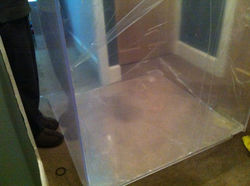
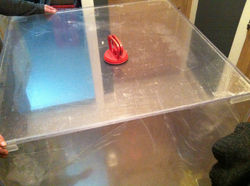
I came up with several different ideas for the construction of the cube itself, but working out the best option was a tricky development process. Initially I was thinking of a wooden structure, however I needed to think of transportation as a 1m3 box would not fit through a standard door. So I developed plans for essentially a flat pack cube, where the sides would slot together on site. Primarily I thought of stretching the paper over the open faces, however I was concerned for it's fragility. From this I concepted using clear acrylic to mount the paper on, though some consideration would have to be made as to how to mount the acrylic onto the wooden structure. Having gone into a hardware store to test materials I found that the cheaper thin acrylic was a bit too flexible at this size and made me doubt this technique. I also saw a drawback to using an internal wooden frame structure, in that It would create very strong internal shadows, obstructing the internal glow. What's more it seemed overly complicated, a simple structure would be a lot more effective, so I considered using only acrylic with thicker more rigid sheet. The only real drawback to this new idea was the cost, thick acrylic costs a lot more then the thinner stuff. However this would create a quick to put up effective structure. So I went about sourcing some acrylic, managing to find some half the price from a building project which got cancelled. 10mmx995mmx995mm.
 |  |  |
|---|---|---|
 |
Acrylic turned out to be a bit of a nightmare material, as most of the sheets were uniform size there was minimal cutting, but the cutting and drilling which needed to be done was very time consuming. What you have to watch out for is the heat of the drill and saw, as it can quite quickly melt the acrylic. We went through several options in terms of the fixings, we new it couldn't fall in due to it's arrangement, so it just needed to support the roof, and to stop the panels falling out. We looked at strong magnets, velcro and suction cups, before realising the cut offs from the acrylic could be used, which would still allow light to pass through (see image left). Wire then hooks between drilled holes both top and bottom pulling the sides together.

Having finished the construction of the cube we decided to test the sound as we weren't to sure what effect it would create, whether it could escape from the cube and the type of reverb, making adjustments to the sound design or cube as a result of the outcome. We found that the hifi was certainly loud enough however it took out all of the bass frequencies, there was also a strong internal reverb within the flat faced cube. We did find however that placing the speakers directly on the face of the cube did minimise the reverb and transferred the bass to vibrations on the faces. What would be great is if instead of fighting against the sound, we utilised it's unique setting.
Sound Test


Visual Image.
Sound Design
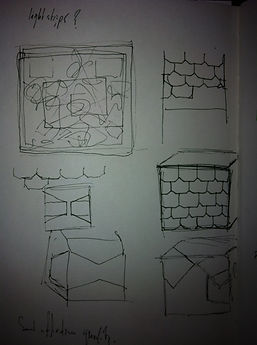
The above sketches were working out the internal AV equipment as well as trying out different ideas. There will be two projectors with 5 faces on the cube which means decisions will have to be made, they could be on opposite sides, adjacent or even projected over two sides, however this would create a very abstract image with parts being out of focus. I need to think about how I can encourage the viewer to walk around the room as opposed to standing still at the watching from the entrance, encouraging interaction with the piece, if they walk to the opposite side of the room there has to be a pay off for them to do so. I also lent consideration to what would be on the blank sides of the cube, playing ideas with having textured paper, or placing tree branches within the cube creating interesting shadows on the sides of the box. I also need to think where the speakers will sit, the internal structure, what the projectors will be sat on, without blocking light or creating shadows, as well as the placement of the LED strip lights.
Prior to this I arranged a group meeting with everybody to fully brief everyone on the vision for the project and what needed to be done specific to each persons specialism, as well as allowing for any questions or concerns raised, though the Cinematographer couldn't make it in. Moreover, the sound designer and I have developed a very close professional relationship and she was involved in the conception and has very similar if not identical thoughts to me, so didn't really need further direction, being already in the loop.
Producer;
-
online advertisement - social media.
-
Posters, information booklets, promotional materials
-
Bloc – 24Hr access? Bar? Advertisement on website? Social media? Payment information, optional extras? Black out facilities
-
Want to get as many people to come as possible by various means, research.
-
Getting projectors below rrp to sell on at equal or greater price after installation.
-
Public liability insurance?
Editor;
-
General running order, description of very loose narrative, flowing from sub urban composed shots of tree lined roads with vanishing points, into the woodland match shots with VP, exploring out into more open landscapes, before going into bleak landscapes. Loops – use interruption/distortion of image.
-
Style – simplistic minimal editing, long takes, try and think of a memory during a shot, cut when it feels right
-
Underwater shot, create perfect loop, understand when not to cut.
Sound;
-
External sound, chaos and confusion of everyday life before dipping into moments of harmony, rumbling bass tones, audience to feel the sound.
-
Internal sound, human and digital voices.

Shooting
My approach to shooting is different compared to when I've directed narrative films, there is a general idea of the types of shots I want, however I don't want to storyboard or over think them as it's not necessary and could sacrifice better shots. I approach it in the same way I treat photography, you need to have an eye for it, to find and compose what is visually beautiful, dependent on many factors including time of day and weather conditions, you cannot preplan this natural eye. In many ways this type of film gives a great freedom. In cinematography it is often said that light is worth 70% of a good image, I am also a great sucker for sunrise shoots, and I new I wanted that tone of light within the images. Often people think that winter is a poor time of year to shoot in due to lack of light and vibrancy of colour, however winter brings it's own tone and it's about knowing how to plan for and capture this. What is great about the winter sun is it is very low in the sky even at mid day, this means there is more atmosphere for the light to travel through, creating a great haze which contributes to the tone of the image. Winter tones usually can vary from blues, often on cold frosty days between 10-11 and 1-2, oranges as with the image above usually captured during rise and set, as well as browns and greys. Moreover, in winter you can get freezing fogs and mists which take great shots either from above looking into a valley basin or within the fog itself, creating sometimes alien desolate images which would actually look very plain and boring in normal conditions. However, you do have to consider light very carefully in your compositions as the light will be the focal point, if not careful you can easily slip into very flat under lit grainy shots, always view light as the subject, especially in winter, if there is no light there is no point. Of course British winters can sometimes make this very difficult especially with long periods of flat grey overcast weather, which is why when I'm looking to get this style of image I will constantly be checking the weather forecast, scheduling my shoots in time for when the sun is out.
Samuel James

 |  |  |
|---|---|---|
 |
The first early morning shoot seemed to go okay and on camera the images looked strong enough, however when we got back and I reviewed the footage with the editor we found a lot of footage was out of focus, and/or not level, and/or with a lot of gain, though there was some salvageable shots, with the leeway on focus due to it being projected small onto paper. The cinematographer I was using wasn't doing it to be marked on the project, rather wanting to be involved/to help out, which is great, but due to the short turn around on the project, and that there are only limited days when the light conditions are right, I couldn't afford another mess up. Though to be fair to her the lenses she was using had very short focal depths as seems to be the norm these days with dslr video. As a fairly competent cinematographer/photographer myself, and as she wasn't available the following day due to running her own project I went out and re shot the following morning as there were similar light conditions. I then had what I thought would be an onerous conversation with her, saying the images weren't to the standard I was looking for, pointing out all of the mistakes. Whilst I was reluctant to have this conversation it turned out to be the right thing to do, she was apologetic and became even more driven to make it right and we went out that night and recorded a very successful time lapse together. Without criticism we would never learn how to improve. However, following shoots similar problems cropped up though mainly with the focusing, by focusing on the foreground instead of where the eye should be drawn to with the composition. Again this is a big problem with using DSLR lenses with very low f/stops, you have to be hyper vigilant and even the best cinematographers can have problems with this.
Following this I also went and did a shoot with the sound designer so that she could record the location sounds, which turned out very successful, the recording swiftly going into the sound design piece. It is something which I secretly really like in a sound artist is someone who uses all their own sounds within their compositions, instead of using online library's, it makes it more personal and original which can only add to the whole piece. Not that I would strongly object to using pre recorded sounds, I just secretly like original recordings. I have found throughout this project more and more that Ruby and I think very similarly and we are very much on the same wavelength (excuse the pun). I've found on multiple occasions I have thought of something which I really need to tell her, but when I go to give that direction she responds "yep I've already done that do you want to listen?" and it is exactly how I imagined it. I feel very privileged to have this form of relationship, it is rare to find someone whom shares your exact vision to collaborate with. She is very motivated and driven and has clearly demonstrated that the project is her top priority. This reassures me that I chose the right person for the job, having originally 6 very interested sound students to choose from.
 |  |  |
|---|---|---|
 |

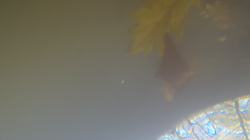
We also captured the footage for the stream loop, by attaching a gopro to a tripod and placing it in a flowing stream, we also tested it in a lake to create an eerie looking up shot. The outcome was slightly different to the initial concept however it very closely matched my developed thought. The leaves flowing towards you in murky waters creating an abstract image which makes viewers question how it was done. Continuing the theme of the leaf and it's temporal lifecycle.
Promotion


I knew from the outset that the look and marketing of the whole installation was of great importance, whilst I gain a lot from doing an installation, a major part of it is getting people to turn up and interact with the piece, otherwise what's the point. My thoughts were to create a uniform style throughout, which started with the creation of this website, which would be linked to via other promotional materials and social networks. Having decided on the name I took a look into fonts, as even the font of the title can effect peoples preconceptions, so I created a fonts look book (above). I narrowed the choices down to open sans, casper, neou, and mensch, all quite modern minimalist fonts which felt right for the installations visual style, before deciding on open sans, as visually this created the best impact for me. I then decided on the crumpled paper background as this linked to the paper wrapped cube, as well as the subject matter of storing memories; they can written on paper and stored. The deep purple/magenta/red tones was mainly a personal choice as a favorite colour of mine. I then translated this style into posters and the information sketch booklet which would be given out on the day.


Above are the information sketch books which will be given out on the day along with a pencil, for people to do with as they please. Maybe sketch an image that came to mind, write down thoughts or their experience of the piece, or if any memories were provoked. They turned out really well, I looked at professional print shops but the prices were way to high, as I am someone who will have a go at anything I decided to create and print them myself. I used hammered textured card to add a luxury feel that contributed to the paper theme. I then printed an image of crumpled paper over the top, which seemed humorous to print paper on paper but it did look good. I then added the deep purple QR code on the back which links to this website. The style is uniform with the website, if you scan the QR you are presented with a very similar digital version of what you are looking at. This in my view gives the installation an identity and allows people to connect further to the project. I feel I have created something which feels a little bit special, making the viewer want to keep it, take it home, acting as a reminder of their experience, taking it outside of the gallery space.
Online social media seemed a great way of getting the installation known about, it's so accessible and used all the time by lots of people. I started by creating links on the website to my linkedin profile for professional contacts, twitter to see what people are tweeting about the project as well as allowing people to show interest, moreover linking to the facebook event page. I decided to have a go at facebook advertising out of curiosity mainly, you often see very commercial advertisement on facebook so to this crop up on the side or as a sponsored story would hopefully be intriguing to someone. I new to draw clicks I had to use a visually strong image to create intrigue, the text SIFT RAM MEM didn't really work in the square format and wasn't striking enough so I used a striking still from the film itself (below).
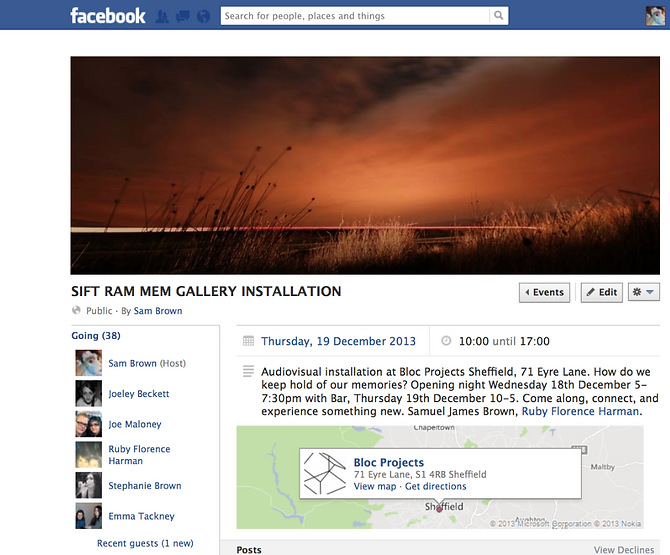
What was interesting was that the sponsored stories part of the advertisement, which shows up in people's news feeds, got far more click throughs then that of the advert itself. Which isn't particularly surprising as the sponsored story crops up in the news feed as opposed to the small square on the right of the screen where people don't look or use ad blockers for. I used filters when setting up the add so that it targeted people within the Sheffield area, who have interests in different art forms. This should be the most effective way of targeting an audience most likely to come. Something I've also noticed when talking to people about the project, they don't know what an installation is, means, or ever heard of one, so to make it more accessible I labeled it gallery installation.
Project update
- Filming completed, rough cut completed
- 1m3 Cube constructed, from acrylic
- projectors sourced
- materials for rubble (wood chip gravel) bought
- large paper sourced, to wrap cube
- developing promotional materials
- Ruby is working on the sound piece
- testing effects of the cube on the internal sound later this week to see if there needs to be some adjustments
Everything is on track, not encountered any major issues as of yet, though a few minors which we have/can overcome, getting excited for the install.
I learnt something interesting today from my father who is a clinical psychologist. The back part of your brain is quick, but the drawback is it’s based on very simple rules; this part is based on primary instincts and fear. Whereas the front of the brain is the creative part which in comparison is very slow. However, stress pushes out the front creative part as the back takes over. As stress is based on fear and reduces you to your primary instincts, making you quick and reactionary.
I found this really interesting as a filmmaker, as there can be huge amounts of stress when working on a project, which would push out the creative thoughts, yet it is those creative thoughts which we depend upon for the success of the project, proving an extremely challenging task. It rings true for me too as my most creative thoughts and inspirations when coming up with an idea or concept usually happens when I’m on break and have very few things to be concerned about. I also feel I think quite slowly, but to great depths and am hugely analytical of everything/one around me. Instead of being reactionary to a situation I often analyse and think at depth about it. Which makes me consider whether I’m running more off of the frontal creative part of the brain.
Before knowing the details of this I already had an awareness of this primal overdrive state, having experienced it myself and witnessed it in others. In my view having an awareness of this information as a director can be extremely useful and if clever about it, can be used when directing others. This could be done by implicitly encouraging them to use the creative part of the brain and by relieving stress and anxiety. This will produce a much better, more creative original end product, then something produced quickly under a high-pressure environment.
Having already worked with the editor in the past and having seen her capabilities, I had already built a level of trust in her judgment. Moreover, she isn’t doing the project for a grade instead because she wants to, so the personal drive is already there. Therefore I used my usual approach with editors which is not to be overly involved or be too specific in what they have to do, as a good editor should look at footage with fresh eyes and may even come up with a better new or different approach. She still had quite a few questions such as; how long should each take last? How long should the film be? What should the distortion look like? For the length of each take my initial direction was “go on feel cut where you think feels right”, this shows my confidence in her decisions reassuring her that I trust her judgment. However, when the same question cropped up later on I said “try and think of a single memory in the duration of each take” setting a small challenge instead of giving a specific answer.
When I’m reviewing an edit with an editor instead of saying what is right or what is wrong or what they have to do, I ask a question, one they may already have the answer to, or one that they haven’t thought of. This allows the editor to really critically reflect about what they have done and it’s effect, whilst encouraging them to use the frontal creative part of the brain instead of using the rear procedural, perhaps giving them a new approach. In my view this is the best way of extracting the full potential of their skill or specialism, which I view as my job as director. In addition to this I use a lot of praise and show gratitude, as this can go a long way, it gives them confidence in what they are doing and it gives value to their time and work.
The end result was exactly what I was looking for, it made me think more about the bigger picture, the harmony between the image, sound and sculpture, how they will all work together, and how it will look visually. It's really interesting bringing together all the individual elements within your head. One of the tutors kindly took a look at purely the film element without knowing about any of the other elements and had a problem with the bad tv effect used for the interruptions, as they referenced a different context from a different era. Which I totally agreed with, and was something I hadn't noticed myself until it was pointed out. There was a suggestion to maybe think of using composite faces to disrupt the image though wasn't something I was initially too sure on but it definitely got me thinking. It took me a while but over the period of a week I toyed with it in my head and realised the reason I didn't like the idea was because the faces were already in the sound track in the form of the voices bubbling out of the central cube, having both elements doing the same thing would be over powering and too direct almost contrived. It got me thinking a lot more about the harmony of the piece as a whole, I wanted the image to be very simple with minimalist editing so as not to overwhelm the viewer within the installation environment. Still the problem arose of the bad tv effect and what to replace it with, I thought of the other elements, the digital voices, how our lives are now becoming stored on digital devices, and came up with using digital distortion as opposed to analogue. Which would fit the piece perfectly without distracting visitors with unrelated contexts. So I asked the editor, who wanted to improve the piece from the feedback, to instead use digital distortion, like a DVD glitching or when a digital tv signal messes up.
Random
Editing
Installation Day
There was a fairly big initial set back in that when I asked the producer for the access codes to the gallery space a couple of days before he said he didn't have them and couldn't get hold of the gallery space for them. Which I realised was a major problem as the gallery runs on a small budget and is staffed wednesday to saturday from 12pm. The original plan was to load the car up with all the non valuable materials the night before to begin wednesday 8:30am. However, there was now an uncertainty as to whether we'd be able to get in before 12, on top of this Ruby managed to borrow some very nice speakers from The Human League's studio, who's sound technician very kindly agreed to deliver and help install them, at 9am. Potentially not being able to get in before 12 was therefore a pretty stressful last minute development. As a result of this I wanted to keep the car empty as a back up to receiving the speakers. Thankfully Ruby managed to get hold of the bloc studios manager (not the gallery) at 7am that morning who very kindly gave us the codes to the gallery and everything went according to plan in terms of the sound. However, this meant I had a ton (quite literally) of equipment and materials to load in the car that morning, which meant I didn't manage to get in until 11:30am pushing us majorly behind on time with 5 and a half hours before we opened to the public.

We started by setting up half of the cube to establish it's presence. From our sound test a couple of weeks before we learnt to make sure all the av is working before putting all the sides up otherwise it makes things very awkward. So our next step was to sort out the av (see image left). This included; extension, HiFi, 2x asus B1M projectors, ipad to play the sound, led strip lights, and two large clear tupperware boxes to support the projectors without blocking light. We made sure the power blocks weren't touching anything and had space as we new they could potentially get hot. At this stage our tutor paid a visit and lent his expertise making us reevaluate the space and the positioning of different elements, whilst also considering the positioning of the projectors and the refraction of light, as well as delving into many other highly useful elements. I am highly appreciative of his help, you could tell he approached it with great insight and professional knowledge. Really great.

I'd say the most time consuming unprepared for part was wrapping the cube in paper which I should have tested and planned more thoroughly before the installation and due to the time pressures we didn't achieve the quality I was looking for. It was hugely stressful having the time pressure of opening for 5 pm and I didn't see how this was going to be done in time, however, we some how managed to pull it off. We learnt a great deal on the day of the installation, which as a trial run development module has been of great use. Since the installation I've come up with a much more effective way to wrap the cube, which could be done before hand saving time and pressure.
Next time I will definitely allow allot more time for the install so that it is a much more enjoyable relaxed environment for everyone involved. I knew in advanced that the success of the piece would rely on lots of very small details everyone of which have to be covered, this time only a couple slipped through the net but it makes me much more prepared for the future. However, as my first installation and on top of that the first public event I've ever organised it turned out pretty good. It was a truly huge learning experience, which makes me more prepared and more determined for future works.
Personal viewpoint
Something which I really wanted to get in the installation was smells, so that we had every sense covered bar taste, moreover smell is one of the strongest senses for provoking a memory. However, I wasn't too sure as to how I'd go about doing this, and ended up buying some allspice and cinnamon sticks to scatter over the woodchip. What I didn't realise or think about until we opened the bags was how much of a strong smell the wood chip in itself gave off, which really pleased me, showing that some small details you don't think of can actually work out good. What drove this home was within about 15 minutes of putting it down and opening the installation someone came out and commented on the smell, telling me what it reminded him of, which I viewed as a great success. This was even before I had chance to sprinkle the spices down which ended up being the following day, which enriched the smell further giving more depth and character, and a member of public managed to pick out the subtle cinnamon smell and commented on it, a further success.
Another unexpected element which turned out very effective, was the refraction and reflection of light on the internal walls of the cube. The projected image bounced off of the glossy acrylic reflecting onto mainly the opposite projected image and the lid of the box, meaning the lid had a combination of both images which looked great. The timelapse footage with the car lights shooting past created quite a strong reflection onto the leafs in the water projection creating abstract flashes of light flashing through the image.
I found Charlotte's editing excellent because the new style of digital distortion/interruption involved different coloured bars, this made the whole cube flash a rich blue at odd occasions which worked in harmony with the experience really well, creating a dynamic change to the cube with a physical disruption. Whilst I'm not sure whether she realised it would have this effect, I certainly didn't, I think it must be really fascinating from an editors perspective; how their work can physically effect and change a 3d sculptural installation experience. It's definitely something we would think of developing for the major project.
Public Reaction
Overall we had very positive feedback, with a total of 36 visitors over the 9.5 hours opening.
"well bloody done, the voices in the box though! so so so good, lovely woodchips, nice wrapping as well, looks brilliant diagonal"
"the more time you spend in there the more personal it becomes" - this was a great rewarding comment to hear from a member of the public, it shows the depth of the piece and it achieved what it set out to do.
A tutor said "for your first installation, this is your first installation?"
When we asked one member of the public how they found out they replied "one of my friends had liked it on facebook" which was great to hear that the social media strategy was beginning to work, and is definitely something we should push for in the next project.
Critical feedback included; "why isn't it open longer" and "it would be better if you could open later as I only just made it from work" Which unfortunately we had confines on time, having to be at AV13 for 8pm and whilst it would have been great to run it for a week, being self funded at this stage makes it an unviable option. However, it is something I agree with and will definitely take into consideration for the major project next semester.
One tutor stated "it's a shame the sound couldn't be more involving" which is something I will work with Ruby on to try and develop further for the major project.

I had intended for the info sketch books to be taken home with the visitors to act as a reminder of their experience, however, I did manage to get a photo of this one. It's interesting seeing the emotions this person felt or went through, overpowering, calm, tension, scary/safe, creating juxtaposing feelings, which shows the dynamic range of the experience, and it's really good to read that someone experienced this level of emotional attachment with the installation.
"An unusual sensory experience. Skillfuly and creatively bringing your attention to the natural beauties around the city that one can often be bypassed or not fully appreciate. Would be great to seen the project developed into an even more immersive and thought provoking experience."
"As I walked in the first thing to hit me was the familiar smell of damp woodland produced from the bark on the floor, quickly followed by a depth of sound and visual stimuli. I watched the images projected through the cube, enjoying the different perspectives, and listened attentively to the sound, trying to pick out the voices and what they were saying, but as I spent longer in the room I found it had a very different effect on me. Those sounds and images and smells began to trigger snatches of reality for me – not a big scenario, but snatches of conversations shared, laughter, solitude, games played in those woods – are we on a bear hunt? - , rendezvous, a meeting of minds and a sharing of souls, splashing down a river walk wearing wellies, cold feet, a scattering of ashes. An undercurrent of memories of a lifetime all running in together. Maybe this lifetime or maybe another. My memories, or maybe somebody else’s? Transient. The only constant being that smell, and those trees, witnessing it all again and again."